
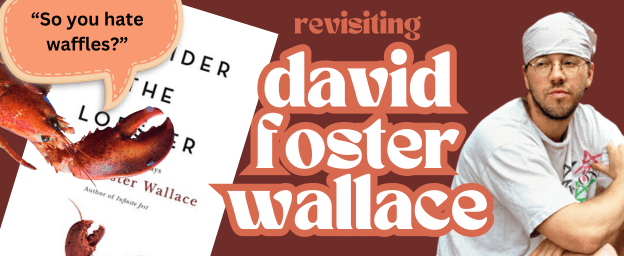
David foster Wallace was an American author and essayist, probably best known for his novel Infinite Jest (1996), which was featured in Time magazine’s list of the 100 best English-language novels published between 1923 and 2005. Infinite Jest is an infamously long and dense read. I admit that I never finished it myself, and sold my copy to a local bookstore following the second in a series of layoffs I experienced throughout the 2010’s and early 2020’s.
But, I didn’t want to talk about Infinite Jest today. I wanted to talk briefly about one piece of Wallace’s work that I have finished, as well as a little bit about Wallace as a writer and how it feels to revisit his writing and some of the ideas presented within in 2024.
Consider the Lobster is an article that was originally published in the August 2003 edition of Gourmet magazine. Gourmet has been out of publication since 2009, but for those of us who remember it, the magazine was considered a premier publication for lovers of fine food, fine wine, and the entire upper-class lifestyle brand that the wealthy middle-to-upper class considered an integral part of their identity.
It was hoity-toity.
I admit that I don’t know much about magazine journalism. Did Gourmet approach Wallace, already an established best-selling author at the time, to attach his name to an in-depth piece about the Maine Lobster Festival? Or did Wallace submit a proposal to the magazine, all along planning in his head the kind of article that he intended to publish? Wallace was not a food writer, and I can’t help but wonder if Gourmet knew what they were getting themselves into at the time.
I had never heard of Wallace before I was a sophomore in college, taking a course in the art of the personal essay as one of my require electives. It was an evening class, taught in a classroom small enough to pass for a closet. I found the class both enjoyable and unchallenging – the former is always a plus regarding college-level course work, the latter less so, but at the time I was thankful for an easy A.
Consider the Lobster was on our list of assigned reading, and for the life of me I cannot remember what else was. I don’t particularly remember the points of discussion that came up in class, either; only the wry reverence with which the professor seemed to hold for David Foster Wallace. It was enough for the man’s name to be imprinted onto my psyche for the rest of time, and I don’t particularly hate that. It was a very 2010’s Academia thing to have happened.
After giving it a read, it’s not hard to get a glimpse at the kind of writer that Wallace is: almost stereotypically post-modern, with a dark sense of humor and an irreverence for a great many of the ideas and institutions that he finds himself surrounded by. Combined with his history of alcoholism, troubled relationships and long battle with depression culminating in his eventual suicide, Wallace is the poster child for the image of the Tortured Writer. His life and the sort of mythos that has sprung up around it has been talked about already, at length, by more than enough people – so I’m going to skip that and just talk about the lobster essay.
The essay starts innocuously enough, with an introduction to the Maine Lobster Fest and all of it’s accompanying attractions, slowly moving into Wallace’s personal experience with the event and culminating in a genuine and intimate discussion on the ethical question of consuming lobster in the first place. The innate selfishness of the act (boiling a living creature alive for the sake of pleasurable consumption) is written in stark contrast to the all-American, “wholesome” pageantry of the festival as well as the magazine itself, a publication that employed such catch-phrases as, “The Magazine of Good Living”.
Author and philosopher Tracy Isaacs examines Wallace’s handling of this topic in greater detail on her blog, Vegan Practically.
But, it’s Wallace’s style of writing that I found to be strangely contemporary, despite the man himself not being around to consider himself so. What Wallace has attempted to do, both in Infinite Jest as well as Consider the Lobster, is replicate the often non-linear nature of human thought through the use of long sentences, with many, many and footnotes baked in.
There is a meta-commentary that runs alongside a piece of Wallace’s writing that seems just as important as the main body of text, but it’s never quite clear whether these notes are crucial or not to the understanding of the greater work until you’ve already taken the time to read them.

It’s as though Wallace, in a desperate bid to not be misunderstood, instead over-explains, citing tangentially-related examples and trying as hard as he possibly can to make sure that what he is saying cannot be confused for what he is not saying.
If this sounds intimately familiar to you, you’ve probably been on Twitter.

Raise your hand if you’ve seen this exact conversation happening somewhere online – be that about politics, philosophy, or fandom. Reading a David Foster Wallace piece feels and awful lot like reading internet discourse, only the discourse is happening at you by the author, rather than with you, as if he has already presupposed any and all arguments you might have with him.
There’s something intimately familiar to this kind of clause-filled writing for those of us who have spent any length of time on Twitter. For every statement made, certain caveats must be stated aloud, lest a single reader feel singled-out, forgotten, or invalidated. Not being perfectly clear as to a Tweet’s intended audience often leads to a flood of ‘what-about-isms’ in the comments below, the context of the original message completely disregarded. Dog-piling by self-righteous keyboard warriors (with tragically poor reading comprehension) and bad actors immediately ensue.
I don’t think that Wallace was intentionally shielding himself from the internet mob by writing in such a way. I doubt he was even aware of such a phenomenon, which was still in its infancy at the time of his death 2008. Nor do I think he would have paid any attention to Twitter were he still alive today. But I could not help but draw this comparison as my eyes flicked upwards and down from the main body of Consider the Lobster‘s text and the stream of footnotes that accompanied it.
I wonder if he felt his writing would be incomplete, inauthentic even, if he did not present his thoughts in their undiluted entirety on the page. My understanding of basic post-modernism is thus: to eschew the the preestablished and the traditional in favor of the authentic. Whether this devotion to an authentic author’s voice was to the benefit or the detriment of his work as a writer, I can’t say for sure – I haven’t read enough of Wallace to have a well-supported opinion either way.
But I can say, for myself at least, that there is a familiarity with his particular brand of oversharing that didn’t really exist in the time before the rise of influencers and Twitter flame wars. We’re living in a different age now – maybe the one Wallace was already living in inside his own mind.
 The Boneyard Blog