One more year passes and once again WordPress reminds me that I still own this website and that they still collect money from my bank account. It came out only a couple of days ago, spurring the thought that I really ought to either contribute something or let the whole thing go. Oddly enough, I also came across this video essay by Sarah Davis Baker that touches on themes of digital decay.
I mentioned in an earlier post that I lamented the loss of internet directories and the thousands of individual websites that used to populate the early internet. I continue to yearn for an internet that more resembled that era, even knowing full well that era is never coming back. As rudimentary as it was, I think it has aged much better than our current commercial, algorithm-driven and AI-saturated era will. I can see the post-2020 internet aging like sour milk if we don’t somehow turn this shit around.
Alongside discussions of both real-life and digital decay, Sarah draws from the themes explored in Jeff Vandermeer’s novel Annihillation, which maintains a solid spot on my need-to-read list (I have seen the film adaptation but from what I hear the novel is very different).
I suppose she’s inspired me to keep this little corner of the internet alive, in a sense. And maybe I feel as though I have nothing to write because the insidious perfectionism of today’s internet culture has gotten its hooks into me – the idea that we cannot and should not share an endeavor, activity or creative work online unless it’s been executed at the highest level. To do otherwise is to be cringe. Okay. So let’s all be cringe. It’s better than the alternative, sanitized and mind-numbingly dull internet we’re careening towards.
There used to be a little book-and-art-and-handmade-goods store on the North Shore of Chattanooga back in the 2010’s, when I was attending university nearby. Coming from the small and culturally dead town that I grew up in, places like these were new, and novel, and made me feel like a real adult just for being within them.
It was in this little store that I was first introduced to the concept of zines.
No one in my family had any association with alternative culture back in the 80’s or 90’s. Punk was just something you called teenagers when they acted out. There was no underground, no second or third option to the quiet, repeating monotony of consumption and tradition that was small town life back then.
All of this to say, I was intrigued – why would someone staple together black and white Xerox prints and sell them for four bucks at a store? What was this?
It was around this time, and thanks to discoveries such as these, that I was introduced to a great many new ideas surrounding governance, economy and class. And many of the zines in that little store were full of such new and alien ideas. But one little booklet in particular contained a singular line that has stuck with me for the past fifteen years:
“I just feel like there is more we can do for one another, as human beings, than buying and selling one another things.”
Given the location of this zine, in a part of the city considered hip and artsy, I recognized the irony of such a statement in a bundle of stapled paper that was, in fact, for sale. But we were all artists in those days, riding the waves of hipster nihilism and irreverence for any and all established structures to unknown horizons. We needed money for beer, American Spirits and rent. We scrounged materials out of the trash and made art to sell. It was beautiful, and fun, and felt so important at the time.
But in the end, none of it ever really liberated us. And even with as many artists who are out there now, with more ways to sell and promote yourself through social media, shows, conventions, and video, I can’t help but feel that the world is no better for it. Paving our own way as artists, eschewing desire for corporate status in favor of a live lived in creativity and honesty, was supposed to fix something. Maybe not everything. but something.
It feels now that for every problem that rises, there is a shirt and a sticker and a hat to be bought, so that you too can show you are part of the solution. There is a new reason to be afraid or disgusted or dissatisfied with things that you already have – but don’t worry, we’ve made a newer, better one with a green label.
And even as art continues to pour from our souls and our bodies, how rare is it now to find art that has not yet put through the wringer of marketability? A feeling become idea become commodity. It’s not wrong to make your living in such a way. Paying your bills by selling keychains, shirts, stickers, mugs, and myriad other goods. Creating art perfectly crafted to move those products off of your shelves and put money in your pocket.
But I don’t want to do it anymore. I am so tired of it all. I am tired of creating more things, copies of ideas, manufactured and packaged and shipped to take up more space in a world so crowded and littered with things. Things can be beautiful. But there are just so many.
I don’t know what to say. What to do about it. With our safeguards and promises failing all around us, I simply feel like there must be something better we can do.
Does anyone else feel like we’ve lost the internet? It’s still here. You’re on it right now. But it doesn’t feel like it’s ours anymore.
It feels like the main thoroughfare of any American city these days: lined with the same dozen or so stores, all owned by the same handful of companies fighting for our attention, while older mom-and-pop businesses are relegated to deteriorating strips or forced out altogether. There are a lot of flaws in comparing the internet to businesses, and the allegory falls apart in places, but that was the first gut reaction I had when thinking about this feeling.
The point being that the internet feels owned. And not by you or me.
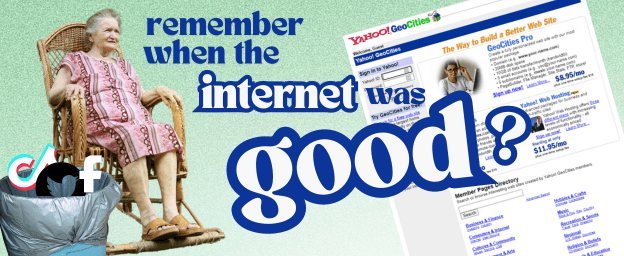
Before the advent of social media and smartphone apps, the internet was more or less divided into websites. And while it was still true then that bigger, more well-known websites with domains of their own were easier to stumble across, there were a handful of website hosting services that allowed anyone with an email address to sign up and create a website of their very own.
I’m sure you remember them: Geocities, Angelfire, and Tripod being the first to come to mind. I used to have a Geocities address of my own. I tried to reach it using the Wayback Machine, but the only timestamps available were from 2009 – shockingly recent for a Geocities website. From what I can tell, it looks like I was using my limited storage space on Geocities as a way to store MP3 files that I could then access from any computer with an internet connection. Not a bad idea, given that things like Dropbox and Google Drive simply didn’t exist yet.
But I think my favorite part of websites like Geocities was the fact that they possessed that absolute treasure trove of content known as a directory. When you built your website, you could list it under any number of categories, so that other users could find it. The topics available ranged anywhere from hobbies to politics to finance, and anyone who was interested could just go down a list of websites and click when one of them seemed promising.
One of the best things about a directory was that each and every link was added by a real human person – not an algorithm (not that a lot of us knew what that word meant back then). Someone had to look at the website, decide whether or not it belonged in said category, and then add it. There was even a ratings system.
Only in the days of directories could we stumble across such beautiful places as K.N.O.T (Kollectors of Nasty Old Ties).
There was just something so wonderfully democratic about this function. We were exposed to a wealth of information online, a massive digital library that was unprecedented at the time – but it still felt human. It still felt like it was ours.
It feels harder than ever now to sift through all the flashing lights, trends, ads, and algorithms pushing a constant stream of content towards us. In this way the internet I feel is worse than it ever has been. It’s no longer democratized, but commercialized, and even our social media profiles don’t feel as if they’re ours anymore. Unfortunately , I don’t have a solution – I’m just another thirty-something online complaining about how things were better back in my day.
But maybe someone with the right stuff can reintroduce us to a democratic internet. To our weird little niche corners with our weird little niche content. To make the internet fun again.
These days, if I see an opportunity to do something, I do it. There’s no hee-hawing, no agonizing over the pros and cons, or wondering whether it would be better to just stay in and marathon some mindless entertainment. This is a major departure from the person I was in my twenties – yes, that person took a handful of solo trips, and once in a blue moon would go out “on the town” because the prospect of spending another night in front of Dragon Age became suddenly unbearable.
But when it came to major life decisions? Building a future and investing time in the things that really mattered? Nah. I had plenty of time.
Not so much any more.
Now, everything I do is fueled by the thought that if I don’t do these things now, they may never happen at all. I’ve spent far too many years using job insecurity and the prospect of moving out of state as excused to never really commit to anything serious. But if I keep waiting for “the right time”, I’ll be waiting forever. It is with this fire lit under my ass that brings me to my most recent accomplishment: a box.
My goal was to create a container for pencils, pens, and other art-making accouterments that you could carry around in your purse or backpack. I wanted it to be made of eco-friendly materials, and I wanted to find a manufacturer here in the United States that could produce it for me at a rate that was viable for re-selling.
I think I accomplished all of those things with one caveat – I seem to have forgotten what pencils are and what they look like, because the dimensions I requested are way off. I could fit a whole Nintendo Switch in this thing. But, that’s the reason we make prototypes.
A pencils case, clearly designed by someone who has never once seen a pencil.
I find myself wondering if each new piece of merchandise I dream up will be the one that will make my career as a working artist. I keep trying – searching for that magic bullet that I can slap a skull onto that will become a viral sensation and allow me to quit my day job. It really is a good thing that I actually enjoy the process of drawing and creating – else this might start to become frustrating.
My day job is, well. A job. And after more than six months of applications and interviews, it’s the first job I’ve been able to snag with both a consistent schedule and half-decent pay. I’ve taught myself the skills necessary to work in nearly every office setting – (Microsoft Office, Adobe, Quickbooks, SEO Optimization, just to name a few…) but so has everyone else, it seems. And despite the chaotic, seat-of-their-pants management style of my current employers, I am thankful for the paycheck. But damned if I don’t want out.
If I had dedicated myself to social media and making cute art with wide appeal from the very day I stepped off of the stage with my diploma? I’d likely be making my living off of my art by now. But I couldn’t have known what steps were necessary to make that dream a reality. None of us did. Those of us who have found that kind of success have often stumbled into it.
But here we are now. And I cannot fathom spending another moment regretting the things I didn’t do when I was younger. I’ve spent way too long doing that already. So let’s get to work.
Since the complete loss of this year’s art show and convention season, with the exception of a few squeezed in before March, all of my sales this year have been online. And nearly all of those sales have been through Etsy.
I’ve been an Etsy user since the early days in 2009, when the platform was still fairly new. Back then I had a little shop where I sold vintage bits and baubles; mostly jewelry and accessories that I’d find in thrift stores or garage sales for dirt cheap, clean up, and then sell for a small profit. I wasn’t even making enough money to consider it a side hustle. I just enjoyed it.
These days, Etsy is my main connection to the folks who normally would have visited my booth at a convention, street festival, or art show. I direct much of the traffic to my Etsy store through social media, though some people come across my shop while browsing the seemingly endless sea of wares that Etsy has to offer. And that is one of the strengths of the platform. There are items for every taste out there, and someone could stumble across your shop fairly easily, if they are browsing for things that share a commonality.
Now, I also sell my prints on various print on demand platforms, such as Redbubble, but I don’t tend to advertise those shops. In fact, if someone wanted to purchase a print from me, I would honestly tell them not to buy from those other sites, and redirect them to my Etsy shop instead. This is because a customer could buy an 8×10 inch print from a print on demand store, and they would pay a fair price for it, but I would only receive a dollar or two in profit from that sale. Meanwhile, in my Etsy shop, I can sell them the same print for a similar price, and the majority of that money will go back into my pockets.
However, there are still costs involved in selling this way, and that’s what I’m going to break down in this post. For my example, I’m going to be focusing on a simple 8×10 inch paper print, since that is what I currently offer in my shop. So, lets start from the beginning.




 The Boneyard Blog