One more year passes and once again WordPress reminds me that I still own this website and that they still collect money from my bank account. It came out only a couple of days ago, spurring the thought that I really ought to either contribute something or let the whole thing go. Oddly enough, I also came across this video essay by Sarah Davis Baker that touches on themes of digital decay.
I mentioned in an earlier post that I lamented the loss of internet directories and the thousands of individual websites that used to populate the early internet. I continue to yearn for an internet that more resembled that era, even knowing full well that era is never coming back. As rudimentary as it was, I think it has aged much better than our current commercial, algorithm-driven and AI-saturated era will. I can see the post-2020 internet aging like sour milk if we don’t somehow turn this shit around.
Alongside discussions of both real-life and digital decay, Sarah draws from the themes explored in Jeff Vandermeer’s novel Annihillation, which maintains a solid spot on my need-to-read list (I have seen the film adaptation but from what I hear the novel is very different).
I suppose she’s inspired me to keep this little corner of the internet alive, in a sense. And maybe I feel as though I have nothing to write because the insidious perfectionism of today’s internet culture has gotten its hooks into me – the idea that we cannot and should not share an endeavor, activity or creative work online unless it’s been executed at the highest level. To do otherwise is to be cringe. Okay. So let’s all be cringe. It’s better than the alternative, sanitized and mind-numbingly dull internet we’re careening towards.
Does anyone else feel like we’ve lost the internet? It’s still here. You’re on it right now. But it doesn’t feel like it’s ours anymore.
It feels like the main thoroughfare of any American city these days: lined with the same dozen or so stores, all owned by the same handful of companies fighting for our attention, while older mom-and-pop businesses are relegated to deteriorating strips or forced out altogether. There are a lot of flaws in comparing the internet to businesses, and the allegory falls apart in places, but that was the first gut reaction I had when thinking about this feeling.
The point being that the internet feels owned. And not by you or me.
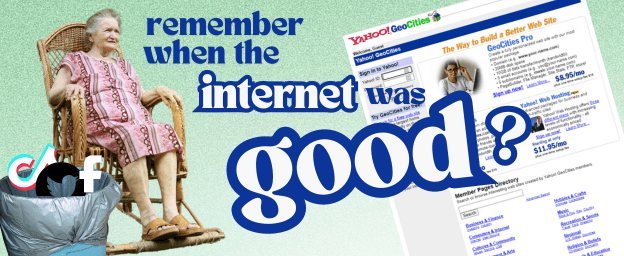
Before the advent of social media and smartphone apps, the internet was more or less divided into websites. And while it was still true then that bigger, more well-known websites with domains of their own were easier to stumble across, there were a handful of website hosting services that allowed anyone with an email address to sign up and create a website of their very own.
I’m sure you remember them: Geocities, Angelfire, and Tripod being the first to come to mind. I used to have a Geocities address of my own. I tried to reach it using the Wayback Machine, but the only timestamps available were from 2009 – shockingly recent for a Geocities website. From what I can tell, it looks like I was using my limited storage space on Geocities as a way to store MP3 files that I could then access from any computer with an internet connection. Not a bad idea, given that things like Dropbox and Google Drive simply didn’t exist yet.
But I think my favorite part of websites like Geocities was the fact that they possessed that absolute treasure trove of content known as a directory. When you built your website, you could list it under any number of categories, so that other users could find it. The topics available ranged anywhere from hobbies to politics to finance, and anyone who was interested could just go down a list of websites and click when one of them seemed promising.
One of the best things about a directory was that each and every link was added by a real human person – not an algorithm (not that a lot of us knew what that word meant back then). Someone had to look at the website, decide whether or not it belonged in said category, and then add it. There was even a ratings system.
Only in the days of directories could we stumble across such beautiful places as K.N.O.T (Kollectors of Nasty Old Ties).
There was just something so wonderfully democratic about this function. We were exposed to a wealth of information online, a massive digital library that was unprecedented at the time – but it still felt human. It still felt like it was ours.
It feels harder than ever now to sift through all the flashing lights, trends, ads, and algorithms pushing a constant stream of content towards us. In this way the internet I feel is worse than it ever has been. It’s no longer democratized, but commercialized, and even our social media profiles don’t feel as if they’re ours anymore. Unfortunately , I don’t have a solution – I’m just another thirty-something online complaining about how things were better back in my day.
But maybe someone with the right stuff can reintroduce us to a democratic internet. To our weird little niche corners with our weird little niche content. To make the internet fun again.



 The Boneyard Blog