One more year passes and once again WordPress reminds me that I still own this website and that they still collect money from my bank account. It came out only a couple of days ago, spurring the thought that I really ought to either contribute something or let the whole thing go. Oddly enough, I also came across this video essay by Sarah Davis Baker that touches on themes of digital decay.
I mentioned in an earlier post that I lamented the loss of internet directories and the thousands of individual websites that used to populate the early internet. I continue to yearn for an internet that more resembled that era, even knowing full well that era is never coming back. As rudimentary as it was, I think it has aged much better than our current commercial, algorithm-driven and AI-saturated era will. I can see the post-2020 internet aging like sour milk if we don’t somehow turn this shit around.
Alongside discussions of both real-life and digital decay, Sarah draws from the themes explored in Jeff Vandermeer’s novel Annihillation, which maintains a solid spot on my need-to-read list (I have seen the film adaptation but from what I hear the novel is very different).
I suppose she’s inspired me to keep this little corner of the internet alive, in a sense. And maybe I feel as though I have nothing to write because the insidious perfectionism of today’s internet culture has gotten its hooks into me – the idea that we cannot and should not share an endeavor, activity or creative work online unless it’s been executed at the highest level. To do otherwise is to be cringe. Okay. So let’s all be cringe. It’s better than the alternative, sanitized and mind-numbingly dull internet we’re careening towards.
There used to be a little book-and-art-and-handmade-goods store on the North Shore of Chattanooga back in the 2010’s, when I was attending university nearby. Coming from the small and culturally dead town that I grew up in, places like these were new, and novel, and made me feel like a real adult just for being within them.
It was in this little store that I was first introduced to the concept of zines.
No one in my family had any association with alternative culture back in the 80’s or 90’s. Punk was just something you called teenagers when they acted out. There was no underground, no second or third option to the quiet, repeating monotony of consumption and tradition that was small town life back then.
All of this to say, I was intrigued – why would someone staple together black and white Xerox prints and sell them for four bucks at a store? What was this?
It was around this time, and thanks to discoveries such as these, that I was introduced to a great many new ideas surrounding governance, economy and class. And many of the zines in that little store were full of such new and alien ideas. But one little booklet in particular contained a singular line that has stuck with me for the past fifteen years:
“I just feel like there is more we can do for one another, as human beings, than buying and selling one another things.”
Given the location of this zine, in a part of the city considered hip and artsy, I recognized the irony of such a statement in a bundle of stapled paper that was, in fact, for sale. But we were all artists in those days, riding the waves of hipster nihilism and irreverence for any and all established structures to unknown horizons. We needed money for beer, American Spirits and rent. We scrounged materials out of the trash and made art to sell. It was beautiful, and fun, and felt so important at the time.
But in the end, none of it ever really liberated us. And even with as many artists who are out there now, with more ways to sell and promote yourself through social media, shows, conventions, and video, I can’t help but feel that the world is no better for it. Paving our own way as artists, eschewing desire for corporate status in favor of a live lived in creativity and honesty, was supposed to fix something. Maybe not everything. but something.
It feels now that for every problem that rises, there is a shirt and a sticker and a hat to be bought, so that you too can show you are part of the solution. There is a new reason to be afraid or disgusted or dissatisfied with things that you already have – but don’t worry, we’ve made a newer, better one with a green label.
And even as art continues to pour from our souls and our bodies, how rare is it now to find art that has not yet put through the wringer of marketability? A feeling become idea become commodity. It’s not wrong to make your living in such a way. Paying your bills by selling keychains, shirts, stickers, mugs, and myriad other goods. Creating art perfectly crafted to move those products off of your shelves and put money in your pocket.
But I don’t want to do it anymore. I am so tired of it all. I am tired of creating more things, copies of ideas, manufactured and packaged and shipped to take up more space in a world so crowded and littered with things. Things can be beautiful. But there are just so many.
I don’t know what to say. What to do about it. With our safeguards and promises failing all around us, I simply feel like there must be something better we can do.
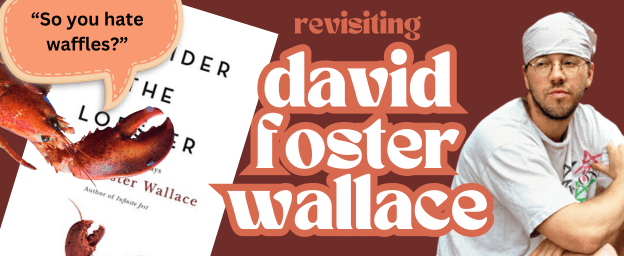
David foster Wallace was an American author and essayist, probably best known for his novel Infinite Jest (1996), which was featured in Time magazine’s list of the 100 best English-language novels published between 1923 and 2005. Infinite Jest is an infamously long and dense read. I admit that I never finished it myself, and sold my copy to a local bookstore following the second in a series of layoffs I experienced throughout the 2010’s and early 2020’s.
But, I didn’t want to talk about Infinite Jest today. I wanted to talk briefly about one piece of Wallace’s work that I have finished, as well as a little bit about Wallace as a writer and how it feels to revisit his writing and some of the ideas presented within in 2024.
A complete narration of ‘Consider the Lobster’ from Youtube user Pallettown.
Consider the Lobster is an article that was originally published in the August 2003 edition of Gourmet magazine. Gourmet has been out of publication since 2009, but for those of us who remember it, the magazine was considered a premier publication for lovers of fine food, fine wine, and the entire upper-class lifestyle brand that the wealthy middle-to-upper class considered an integral part of their identity.
It was hoity-toity.
I admit that I don’t know much about magazine journalism. Did Gourmet approach Wallace, already an established best-selling author at the time, to attach his name to an in-depth piece about the Maine Lobster Festival? Or did Wallace submit a proposal to the magazine, all along planning in his head the kind of article that he intended to publish? Wallace was not a food writer, and I can’t help but wonder if Gourmet knew what they were getting themselves into at the time.
I had never heard of Wallace before I was a sophomore in college, taking a course in the art of the personal essay as one of my require electives. It was an evening class, taught in a classroom small enough to pass for a closet. I found the class both enjoyable and unchallenging – the former is always a plus regarding college-level course work, the latter less so, but at the time I was thankful for an easy A.
Consider the Lobster was on our list of assigned reading, and for the life of me I cannot remember what else was. I don’t particularly remember the points of discussion that came up in class, either; only the wry reverence with which the professor seemed to hold for David Foster Wallace. It was enough for the man’s name to be imprinted onto my psyche for the rest of time, and I don’t particularly hate that. It was a very 2010’s Academia thing to have happened.
After giving it a read, it’s not hard to get a glimpse at the kind of writer that Wallace is: almost stereotypically post-modern, with a dark sense of humor and an irreverence for a great many of the ideas and institutions that he finds himself surrounded by. Combined with his history of alcoholism, troubled relationships and long battle with depression culminating in his eventual suicide, Wallace is the poster child for the image of the Tortured Writer. His life and the sort of mythos that has sprung up around it has been talked about already, at length, by more than enough people – so I’m going to skip that and just talk about the lobster essay.
The essay starts innocuously enough, with an introduction to the Maine Lobster Fest and all of it’s accompanying attractions, slowly moving into Wallace’s personal experience with the event and culminating in a genuine and intimate discussion on the ethical question of consuming lobster in the first place. The innate selfishness of the act (boiling a living creature alive for the sake of pleasurable consumption) is written in stark contrast to the all-American, “wholesome” pageantry of the festival as well as the magazine itself, a publication that employed such catch-phrases as, “The Magazine of Good Living”.
Author and philosopher Tracy Isaacs examines Wallace’s handling of this topic in greater detail on her blog, Vegan Practically.
But, it’s Wallace’s style of writing that I found to be strangely contemporary, despite the man himself not being around to consider himself so. What Wallace has attempted to do, both in Infinite Jest as well as Consider the Lobster, is replicate the often non-linear nature of human thought through the use of long sentences, with many, many and footnotes baked in.
There is a meta-commentary that runs alongside a piece of Wallace’s writing that seems just as important as the main body of text, but it’s never quite clear whether these notes are crucial or not to the understanding of the greater work until you’ve already taken the time to read them.
(Seen here, an excerpt from Consider the Lobster, including a short critique of tourism in the footnotes that could pass for part of a completely different article. Source: Columbia University Digital Library)
It’s as though Wallace, in a desperate bid to not be misunderstood, instead over-explains, citing tangentially-related examples and trying as hard as he possibly can to make sure that what he is saying cannot be confused for what he is not saying.
If this sounds intimately familiar to you, you’ve probably been on Twitter.
Raise your hand if you’ve seen this exact conversation happening somewhere online – be that about politics, philosophy, or fandom. Reading a David Foster Wallace piece feels and awful lot like reading internet discourse, only the discourse is happening at you by the author, rather than with you, as if he has already presupposed any and all arguments you might have with him.
There’s something intimately familiar to this kind of clause-filled writing for those of us who have spent any length of time on Twitter. For every statement made, certain caveats must be stated aloud, lest a single reader feel singled-out, forgotten, or invalidated. Not being perfectly clear as to a Tweet’s intended audience often leads to a flood of ‘what-about-isms’ in the comments below, the context of the original message completely disregarded. Dog-piling by self-righteous keyboard warriors (with tragically poor reading comprehension) and bad actors immediately ensue.
I don’t think that Wallace was intentionally shielding himself from the internet mob by writing in such a way. I doubt he was even aware of such a phenomenon, which was still in its infancy at the time of his death 2008. Nor do I think he would have paid any attention to Twitter were he still alive today. But I could not help but draw this comparison as my eyes flicked upwards and down from the main body of Consider the Lobster‘s text and the stream of footnotes that accompanied it.
I wonder if he felt his writing would be incomplete, inauthentic even, if he did not present his thoughts in their undiluted entirety on the page. My understanding of basic post-modernism is thus: to eschew the the preestablished and the traditional in favor of the authentic. Whether this devotion to an authentic author’s voice was to the benefit or the detriment of his work as a writer, I can’t say for sure – I haven’t read enough of Wallace to have a well-supported opinion either way.
But I can say, for myself at least, that there is a familiarity with his particular brand of oversharing that didn’t really exist in the time before the rise of influencers and Twitter flame wars. We’re living in a different age now – maybe the one Wallace was already living in inside his own mind.
Does anyone else feel like we’ve lost the internet? It’s still here. You’re on it right now. But it doesn’t feel like it’s ours anymore.
It feels like the main thoroughfare of any American city these days: lined with the same dozen or so stores, all owned by the same handful of companies fighting for our attention, while older mom-and-pop businesses are relegated to deteriorating strips or forced out altogether. There are a lot of flaws in comparing the internet to businesses, and the allegory falls apart in places, but that was the first gut reaction I had when thinking about this feeling.
The point being that the internet feels owned. And not by you or me.
Before the advent of social media and smartphone apps, the internet was more or less divided into websites. And while it was still true then that bigger, more well-known websites with domains of their own were easier to stumble across, there were a handful of website hosting services that allowed anyone with an email address to sign up and create a website of their very own.
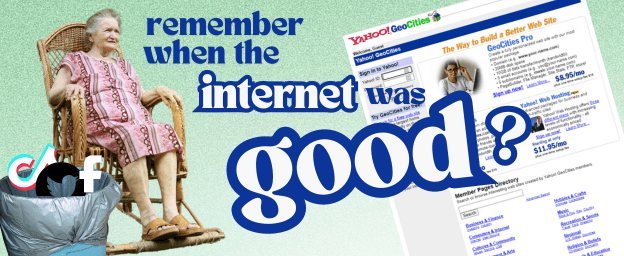
I’m sure you remember them: Geocities, Angelfire, and Tripod being the first to come to mind. I used to have a Geocities address of my own. I tried to reach it using the Wayback Machine, but the only timestamps available were from 2009 – shockingly recent for a Geocities website. From what I can tell, it looks like I was using my limited storage space on Geocities as a way to store MP3 files that I could then access from any computer with an internet connection. Not a bad idea, given that things like Dropbox and Google Drive simply didn’t exist yet.
But I think my favorite part of websites like Geocities was the fact that they possessed that absolute treasure trove of content known as a directory. When you built your website, you could list it under any number of categories, so that other users could find it. The topics available ranged anywhere from hobbies to politics to finance, and anyone who was interested could just go down a list of websites and click when one of them seemed promising.
One of the best things about a directory was that each and every link was added by a real human person – not an algorithm (not that a lot of us knew what that word meant back then). Someone had to look at the website, decide whether or not it belonged in said category, and then add it. There was even a ratings system.
Only in the days of directories could we stumble across such beautiful places as K.N.O.T (Kollectors of Nasty Old Ties).
There was just something so wonderfully democratic about this function. We were exposed to a wealth of information online, a massive digital library that was unprecedented at the time – but it still felt human. It still felt like it was ours.
It feels harder than ever now to sift through all the flashing lights, trends, ads, and algorithms pushing a constant stream of content towards us. In this way the internet I feel is worse than it ever has been. It’s no longer democratized, but commercialized, and even our social media profiles don’t feel as if they’re ours anymore. Unfortunately , I don’t have a solution – I’m just another thirty-something online complaining about how things were better back in my day.
But maybe someone with the right stuff can reintroduce us to a democratic internet. To our weird little niche corners with our weird little niche content. To make the internet fun again.
These days, if I see an opportunity to do something, I do it. There’s no hee-hawing, no agonizing over the pros and cons, or wondering whether it would be better to just stay in and marathon some mindless entertainment. This is a major departure from the person I was in my twenties – yes, that person took a handful of solo trips, and once in a blue moon would go out “on the town” because the prospect of spending another night in front of Dragon Age became suddenly unbearable.
But when it came to major life decisions? Building a future and investing time in the things that really mattered? Nah. I had plenty of time.
Not so much any more.
Now, everything I do is fueled by the thought that if I don’t do these things now, they may never happen at all. I’ve spent far too many years using job insecurity and the prospect of moving out of state as excused to never really commit to anything serious. But if I keep waiting for “the right time”, I’ll be waiting forever. It is with this fire lit under my ass that brings me to my most recent accomplishment: a box.
My goal was to create a container for pencils, pens, and other art-making accouterments that you could carry around in your purse or backpack. I wanted it to be made of eco-friendly materials, and I wanted to find a manufacturer here in the United States that could produce it for me at a rate that was viable for re-selling.
I think I accomplished all of those things with one caveat – I seem to have forgotten what pencils are and what they look like, because the dimensions I requested are way off. I could fit a whole Nintendo Switch in this thing. But, that’s the reason we make prototypes.
A pencils case, clearly designed by someone who has never once seen a pencil.
I find myself wondering if each new piece of merchandise I dream up will be the one that will make my career as a working artist. I keep trying – searching for that magic bullet that I can slap a skull onto that will become a viral sensation and allow me to quit my day job. It really is a good thing that I actually enjoy the process of drawing and creating – else this might start to become frustrating.
My day job is, well. A job. And after more than six months of applications and interviews, it’s the first job I’ve been able to snag with both a consistent schedule and half-decent pay. I’ve taught myself the skills necessary to work in nearly every office setting – (Microsoft Office, Adobe, Quickbooks, SEO Optimization, just to name a few…) but so has everyone else, it seems. And despite the chaotic, seat-of-their-pants management style of my current employers, I am thankful for the paycheck. But damned if I don’t want out.
If I had dedicated myself to social media and making cute art with wide appeal from the very day I stepped off of the stage with my diploma? I’d likely be making my living off of my art by now. But I couldn’t have known what steps were necessary to make that dream a reality. None of us did. Those of us who have found that kind of success have often stumbled into it.
But here we are now. And I cannot fathom spending another moment regretting the things I didn’t do when I was younger. I’ve spent way too long doing that already. So let’s get to work.
This is going to be a messy stream of thoughts more than anything else, but it’s a question that’s been rattling around in my head for some time now.
I’ve been in the process of packing up my entire house in preparation for a move that was supposed to happen last year. Life and financial circumstances have thrown a wrench in my moving plans, as they have a habit of doing, but I should be on track to move some time in the late summer or fall.
But, as a result, my online store has been on haitus for some time now. All of my prints, stickers, journals and other merchandise have been packed away in storage, where they will likely stay until I get settled into my new place. In the meantime, I’ve been spending time not only making new art, but researching new merch that I might be able to sell once I re-open my online sales.
This has led me to a disheartening realization.
There are plenty of artists whom I follow online that have shops of their own. And I’ve purchased prints and other goods from these shops myself. I want to support my fellow artists after all, and the things that they create are far and above anything that I can find in mass-production.
However, I’ve come to learn that while the enamel pins, cute handbags and flower-covered skirts that I adore may have been designed by an independent artist, they were more than likely manufactured overseas in a Chinese factory, just like the items produced for large retailers.
I understand why artists would be tempted to do this. China has more manufacturing capabilities than any other country in the world. If you can dream it up, there’s a company in China that can manufacture it for you. Not only that, but they can do so for prices that make it possible for you to turn a profit on your merchandise. For an independent artist who may rely on merch sales for a large part of their income, it’s important to have profit margins of at least thirty percent on the items that you sell, with fifty percent or more being the ideal.
It sounds like a good deal. But in 2023, you would be hard-pressed to find a person who isn’t at least somewhat aware of the unsafe working conditions in Chinese factories, the poverty wages and inhumane hours that citizens are required to work, as well as the environmental impacts of China’s unregulated manufacturing practices.
Unethical business practices and human rights violations aside, there’s also the high probability of intellectual property theft when doing business with Chinese manufacturers. Many an artist has produced their enamel pins, jewelry and other items using a Chinese factory, only to see their original designs pop up on Ali Express, Wish, and other marketplaces months later, usually at a fraction of the price of buying it from the artist’s own store.
Clothing manufacturing workers in Guangzhou, China. (Source: Fashion Magazine)
None of this is uncommon knowledge. Human rights groups and consumers alike have known for decades that there is a human and environmental cost to the cheap manufacturing services that China can offer. Large corporations like Wal-Mart and Amazon continue to do business with them, because their main concern is to produce a product as cheaply as possible for a market of people who want to buy it as cheaply as possible. That kind of business model has come to be expected from them.
But, as independent creators and artists, I thought we were supposed to do better.
And yet, take a look on Etsy or take a stroll down the artist’s alley of any popular convention, and your eyes are sure to be graced with acrylic charms, enamel pins, plushies, clothing, novelty handbags and other items that had a Chinese manufacturer to thank for their existence.
I have continued to sit and ponder this dilemma, and there’s really no easy answer to be found here. Many popular items, such as enamel pins, can’t be manufactured anywhere else but China due to regulations that are designed to keep our air, water, and soil uncontaminated. And while an artist may be able to find a factory in the United States, United Kingdom, or other country with higher labor standards, they may not be able to make enough profit off of the items to make a living selling them.
So what is there left to do?
There are some signs pointing to improving conditions in the Chinese labor market. But, so far, these cases seem to be the exception. Unless things improve in a more permanent, widespread way, are artists just supposed to turn a blind eye to the labor practices that their money is supporting?
We need to make a living. But the idea of making a living as an artist at the cost of human suffering makes me feel ill.
I’ve done my best to make sure all of my merchandise is manufactured stateside – my prints come from New York, my journals are printed in Schaumburg, Illinois, and my wooden charms were handmade by Arcanic Artistry – a company who, at the time, was run out of a garage three miles from my home in Orlando, Florida. But it’s become clear to me that this stance is greatly hindering both my profit margins, as well as the variety of merchandise that I will be able to offer.
There’s an irony to being able to make a living selling products that you designed yourself, but relied on cheap overseas manufacturing to produce. Being a full-time artist means that you don’t have to rely on low-paying, back-breaking labor to make ends meet. You are able to use the skills you’ve cultivated to do work that makes you happy. It’s just a shame if you are only able to do so because someone else, whom you will ever meet or see, is shouldering the burden of the low-paying, back-breaking labor that you managed to avoid.
I’m going to continue digging deep in my search for more ethical, local manufacturing options. If that means that there will never be a single enamel pin in my store, so be it. I feel as though I’ve only scratched the surface of what might be available out there, but I’m willing to keep doing the work.
(If any artists out there have any tips and tricks for finding ethical manufacturers who are willing and able to work with small, independent companies, then feel free to share them below.)
Sometimes I forget that blogs are still a relevant medium. Especially right now in the age of “influencer” somehow being a legitimate career path, and Instagram and Youtube being the primary methods these days of dispersing messages and ideas, blogs almost seem antiquated.
But, hell if I don’t love the written word.
There is a distance created between the author and the reader that I find comforting. It is a way of putting down your ideas thoughtfully and carefully, with time to stop and think in between sentences. We’re not exactly graced with that sort of time in person. And as a writer, what need is there for you to present a friendly, charismatic persona that makes people click buttons to show their approval of your speech and appearance? I say, none.






 The Boneyard Blog